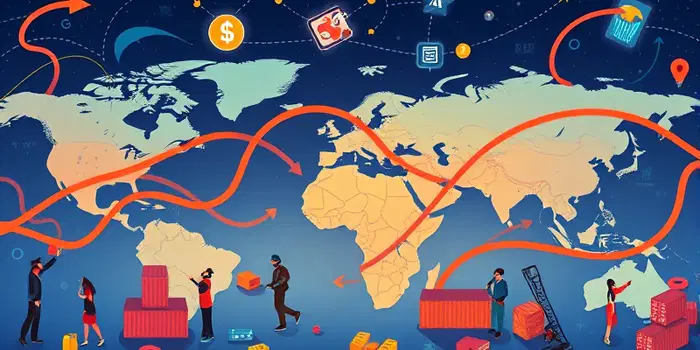
Global markets are in constant flux, driven by forces that redefine how businesses operate and societies prosper. Navigating these complexities requires both vision and practical knowledge. This article unpacks the key factors shaping international trade in 2026, offering insights and actionable strategies.
Understanding core definitions of market dynamics is the first step toward success. Global market dynamics involve changes in customer demand, supply chains, and pricing structures, influenced by geopolitical events, consumer trends, and technological advances.
Companies must distinguish short-term trends from long-term transformation to build strategies that stand the test of time.
The world economy faces a modest expansion in 2026, with overall growth projected at 2.6%. While developing nations (excluding China) are expected to grow at 4.2%, advanced economies will see slower gains. The United States forecast stands at 1.5%, down from 1.8% in 2025, and China’s growth is tempered to 4.6% from 5%.
In 2025, global trade reached a record $35 trillion, marking a 7% increase and highlighting the resilience of cross-border commerce despite rising tensions.
Ten powerful trends are redefining how goods and services move across borders. Companies that anticipate and adapt to these shifts will seize opportunities and mitigate risks.
1. Rising Protectionism: Tariff escalation continues as governments seek to protect strategic industries. Expect sharper duties on semiconductors and critical minerals under Section 232, challenging established supply networks.
2. Value Chain Reconfiguration: Geopolitical and climate pressures are driving firms to diversify suppliers and relocate production closer to end markets. This risk management over cost efficiency approach fosters resilient, adaptive supply networks.
3. Trade Rule Reform: The WTO’s 14th ministerial conference in Yaoundé faces hurdles from unilateral tariffs and geopolitical clashes. Developing nations push to restore dispute settlement, preserve policy space, and advance digital trade talks.
4. Regional & South-South Expansion: East and Southeast Asia’s regional value chains are surging, while Africa now directs over half its exports to fellow developing markets. Strengthening Africa–Latin America links offers additional resilience.
5. Environmental Integration: With 113 countries enhancing climate pledges, trade rules will embed carbon pricing, deforestation regulations, and green standards. Developing nations must secure green finance and technology to stay competitive.
6. Non-Tariff Measures: Security, environmental, and public health standards are proliferating. Small exporters face high compliance costs, underscoring the need for flexible rules and targeted assistance.
7. Geopolitical Reshaping: Access to critical resources and energy security is a new battleground. Regional tensions can disrupt routes and create volatility, making strategic alliances essential.
8. Currency Dynamics & De-dollarization: A softer dollar through 2026 eases conditions for emerging markets. Tokenized cross-border payments, adopted by three-quarters of G20 economies, accelerate transactions and support de-dollarization.
The global supply chain is a delicate ecosystem, adapting to production shifts, resource scarcity, and consumer preferences. Manufacturing relocation to emerging economies lowers costs but can introduce logistical bottlenecks.
Climate change and population growth intensify resource scarcity, pushing prices upward and prompting innovations in materials and processes. Businesses must embrace adaptive sourcing and alternative materials to thrive.
On the demand side, megacities in developing nations are fueling a burgeoning middle class. From consumer electronics to luxury goods, enterprises that tailor offerings to diverse demographics will capture new markets.
Global population trends—aging societies, accelerating urbanization, and changing income distribution—redefine consumption patterns. The rise of a middle class in China, India, and beyond represents a monumental shift in purchasing power.
Businesses that align products and services with the aspirations of these emerging consumers stand to gain. In India, strong GDP growth fueled by exports and consumption highlights the potential of well-targeted strategies.
Several economies enter 2026 with structural advantages: disciplined central bank policies, controlled inflation, and healthier balance sheets. Exposure to global capital expenditure cycles further bolsters their resilience.
Commodity-linked nations benefit from infrastructure investments, rising energy demand, and electrification trends driven by AI and reshoring. Geographic winners include:
Softer dollar conditions increase capital inflows and create opportunities for exporters in these regions.
Digital technologies are rewriting market rules. AI investment is poised to approach $500 billion in 2026, unlocking new growth avenues in chips, healthcare, and manufacturing.
Big data analytics streamlines operations, blockchain enhances transparency, and 5G expands connectivity. Firms that leverage these innovations can outpace competitors and deliver superior customer experiences.
Success in international markets rests on rigorous market research, deep consumer insights, and an agile approach to regulatory changes. Companies need to monitor regional landscapes and anticipate emerging risks.
By embracing sustainability, harnessing AI, and staying attuned to geopolitical currents, businesses can transform challenges into long-term competitive advantages. A proactive, informed strategy is the key to thriving in the global marketplace of 2026 and beyond.
References